
XGO-Ranger: Desktop Bipedal Self-Balancing Robot
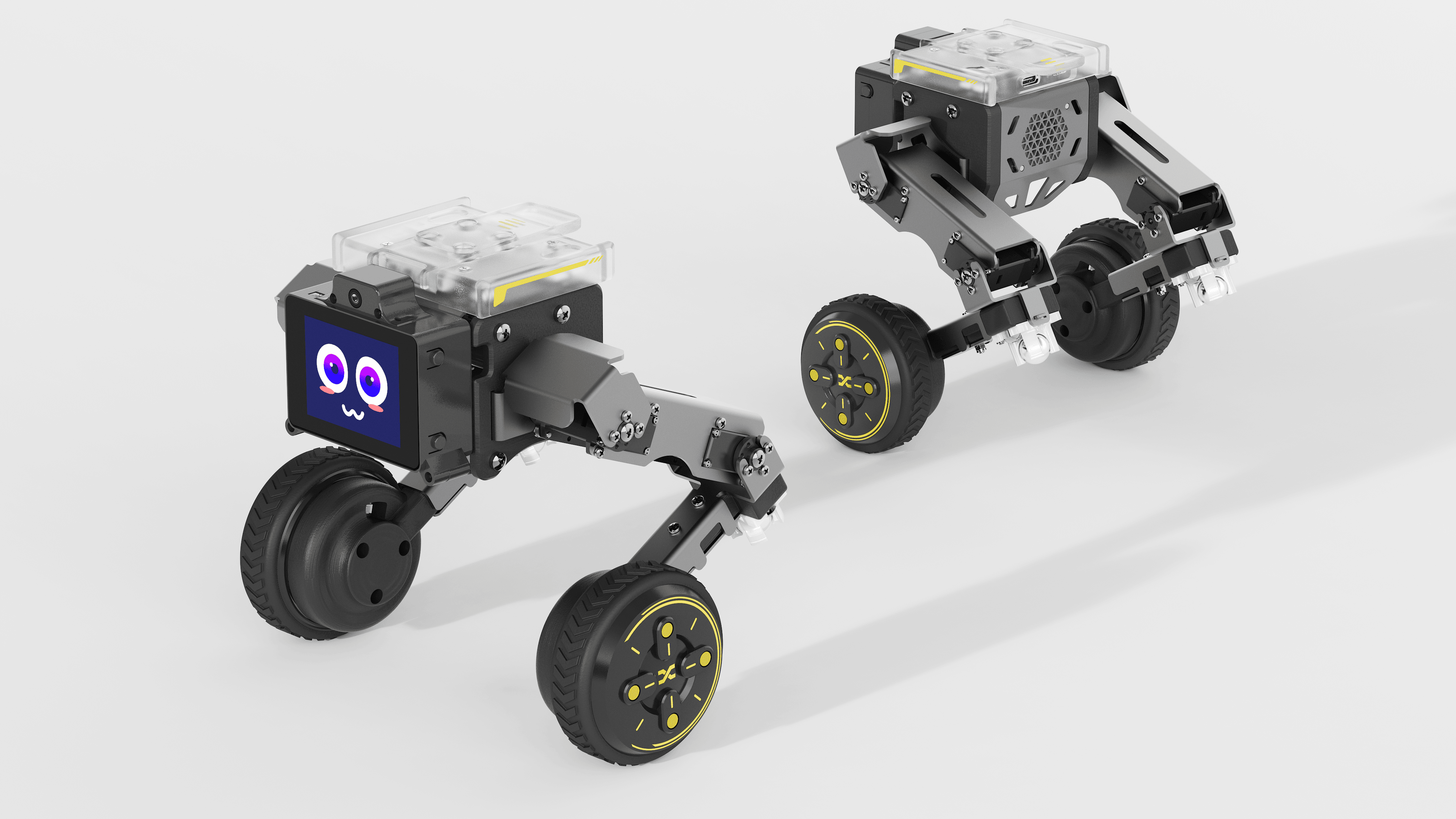
1. Overview: The Minimalist Bipedal Hybrid
The XGO-Ranger marks another milestone in the XGO family's exploration of wheeled-legged locomotion. By stripping down the architecture into a minimalist bipedal (self-balancing wheeled-legged) form factor, it breaks away from traditional quadruped configurations to deliver purer dynamic control and a more futuristic aesthetic impact.
Inheriting the signature wheeled-legged integration gene of the XGO series, the Ranger boasts ultra-fast data processing and attitude response speeds. It seamlessly executes dynamic self-balancing, pitch adjustment, gait/form-switching, and zero-radius 360° high-speed spins. The XGO-Ranger is the ultimate desktop-grade wheeled-legged control platform purpose-built for geeks, university researchers, and robotics developers.
2. Key Innovations
Bipedal Self-Balancing & Dynamic Attitude Control
Unlike the static stability of quadrupeds, the XGO-Ranger utilizes a bipedal wheeled-legged architecture. Powered by a high-precision IMU (Inertial Measurement Unit) paired with the millisecond-level response of FOC motors, the robot exhibits exceptional self-balancing and disturbance-rejection capabilities—whether standing completely still, cruising at high speeds, or enduring external impacts.
Multi-Dimensional Wheeled-Legged Locomotion
Dynamic Height & Pose Adjustment: Driven by multi-DOF (Degrees of Freedom) bus servos on both legs, the Ranger can freely lower its chassis to drop its center of gravity for high-speed cruising, or elevate itself for extended field of view and obstacle clearance.
Omnidirectional Trick Locomotion: Supports zero-radius 360° pivot turns, rapid fore-and-aft pitch manipulations, and seamless transitions between different movement modes.
3. Technical Specifications & Feature Matrix
Feature | XGO-Ranger |
|---|---|
Form | Desktop self-balancing wheeled-legged robot |
Computer / controller | Raspberry Pi CM5, 4 GB / ESP32 |
Actuators | 6 (4 leg servos + 2 powered wheels) |
Robotic arm | None |
Leg servos | 6 V, 4.5 kg·cm, metal housing, steel gears, 360° magnetic encoder, dual-shaft TTL serial bus |
Wheel motors | 4012 FOC brushless hub motors |
Motion modes | Wheeled-legged self-balancing mode and car (four-wheel) mode |
Structure | 1.5 mm aluminum alloy |
Legs and feet | Silicone + ABS |
Weight | 730 g |
Default standing dimensions | 160 × 120 × 130 mm |
Battery | 18500, 2S, 1400 mAh |
Charging | USB Type-C |
Typical runtime | Approximately 2 hours |
Development | Python and ROS |
Using Ranger features
Use the Ranger-specific controls in Remote Control & Video Streaming. The App switches between wheeled-legged and car modes.
Face-follow and gesture-recognition motion feedback work only in wheeled-legged mode. Ranger has no gripper and does not support ball grasping.
The gyroscope / posture self-stabilization control takes effect only in wheeled-legged mode.
In Group Show, Ranger uses the model code R. Select its six supported actions instead of quadruped actions.