
XGO-Rider2: The World's First Desktop Wheeled-Legged AI Robot
(Originally funded by backers on Kickstarter, XGO-Rider2 has evolved from a crowdfunding sensation into the standard platform for desktop control theory research.)
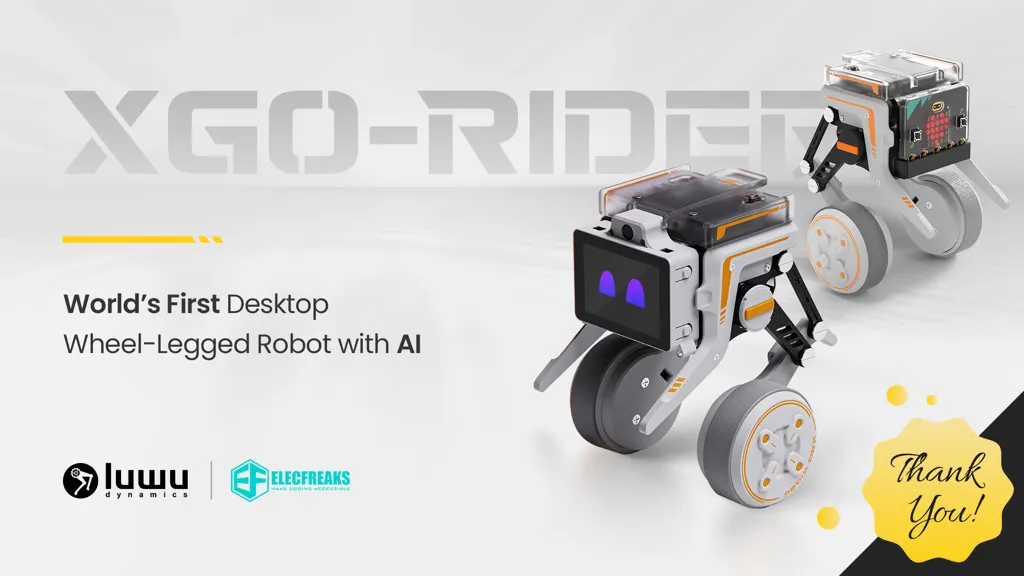
XGO-Rider, World’s First Desktop Wheel-Legged Robot with AI
1. Product Overview
XGO-Rider2 is a desktop-level wheeled-legged robot powered by the Raspberry Pi CM5. Unlike traditional robots that either roll (efficient but limited) or walk (adaptable but slow), the Rider2 combines the best of both worlds.
It utilizes a Hybrid Drive System:
·Wheels: Integrated FOC (Field Oriented Control) Hub Motors for silent, high-speed, self-balancing movement.
·Legs: High-torque 4.5kg.cm serial bus servos acting as a variable suspension system.
This unique architecture allows it to perform omni-directional motion, adjust its body height dynamically, and navigate complex terrain with the agility of a biological system.
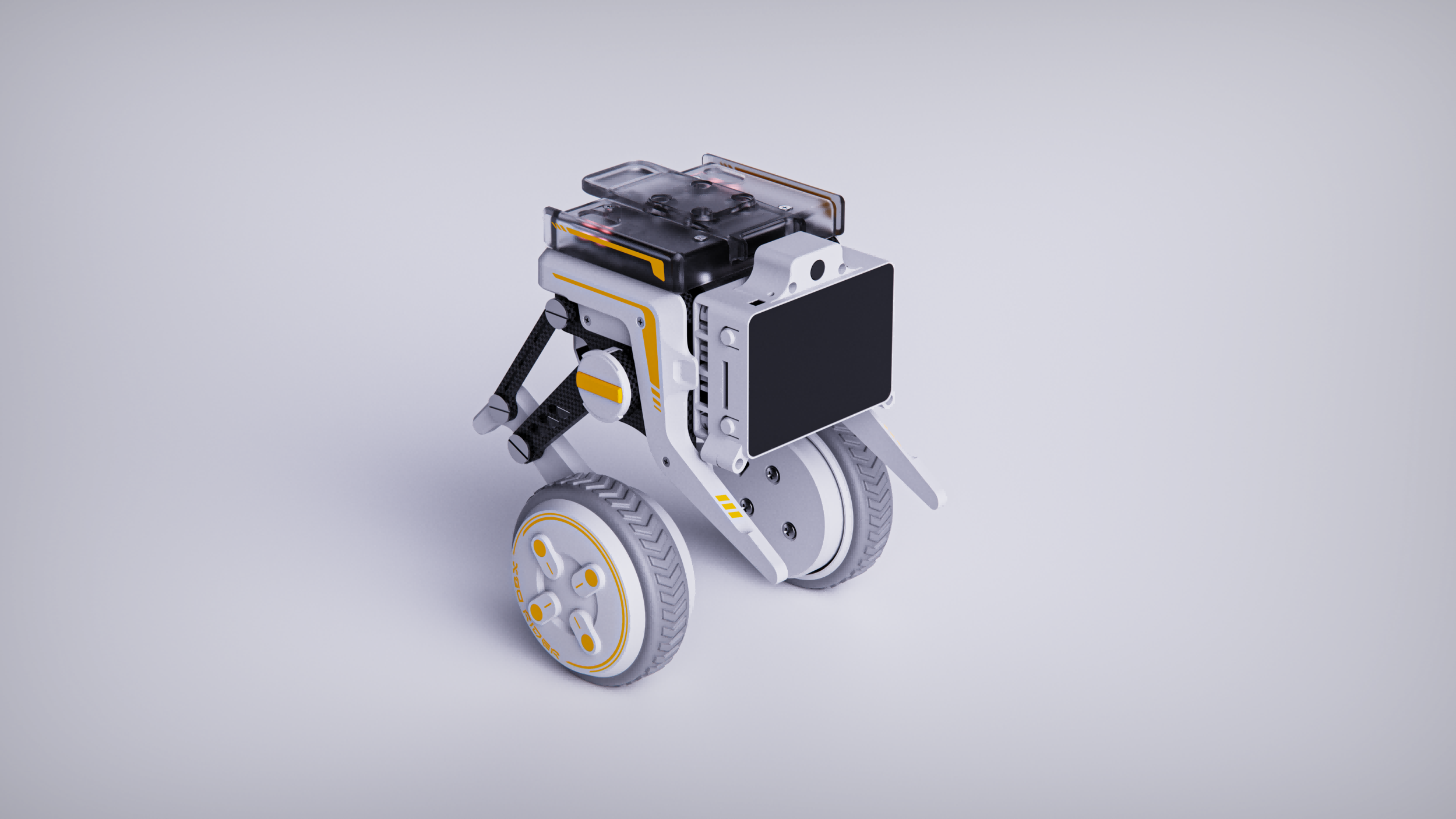
Fig.1 XGO-Rider2
2. Core Technologies
Industrial-Grade Self-Balancing: Leveraging a high-precision IMU and closed-loop control algorithms, XGO-Rider2 acts as a programmable Inverted Pendulum. It maintains perfect stability even when carrying payloads or traversing uneven surfaces.
FOC Silent Maneuvering:The brushless hub motors are driven by Field Oriented Control (FOC) technology. This provides high torque density and whisper-quiet operation, making it perfect for classroom and office environments.
Edge AI Computing (CM5):With the built-in Raspberry Pi CM5, Rider2 is capable of running:
·Computer Vision: Face/Gesture recognition via the 5MP camera.
·LLM Interaction: Voice conversations using ChatGPT.
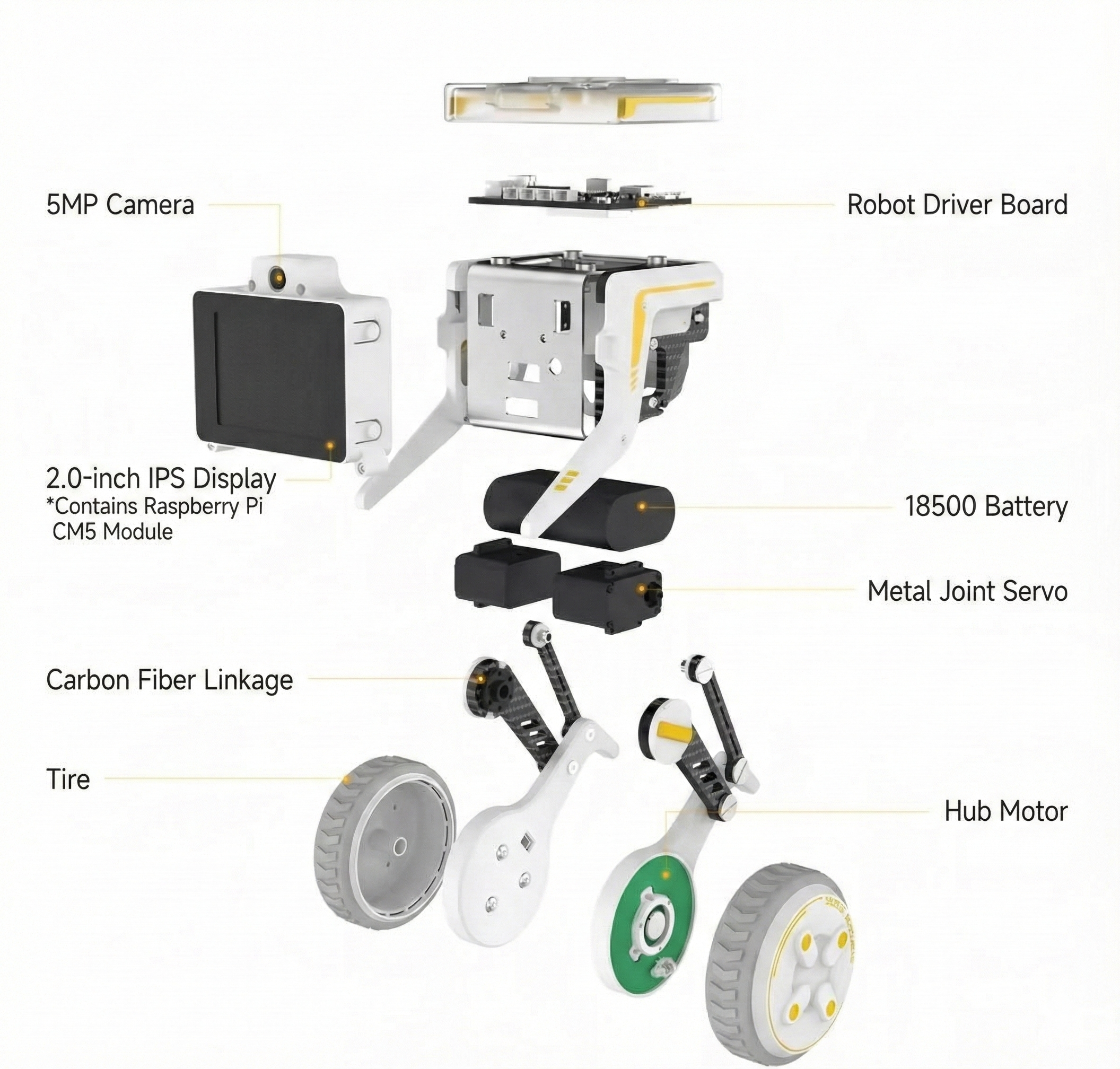
Fig.2 XGO-Rider2 exploded view
3. Developer & Research Value
XGO-Rider2 is widely used in universities for teaching Modern Control Theory:
·LQR (Linear-Quadratic Regulator): Students can tune the balancing parameters directly in Python.
·Kinematic Decoupling: Study how to isolate body posture (Pitch/Roll) from wheel movement.
·Secondary Development: Full access to the ESP32 lower computer and structural STP files.
4. XGO-Rider2 Specifications
4.1 General Parameters
The XGO-Rider2 integrates high-performance computing with a lightweight, variable-height chassis structure.
Parameter | Value |
|---|---|
Model | XGO-Rider2 |
Processor | Raspberry Pi CM5 (Quad-Core) + ESP32 (Co-processor) |
Dimensions | 135 *118 *116-158)(Variable Height) |
Weight | 560g |
Materials | Body: Aviation Aluminum & ABS |
Display | 2.0 inch IPS (320*240) |
Vision Sensor | 5-Mega-Pixel OV5647 Camera |
Audio System | Mic: Double MEMS |
Storage | 32GB Micro-SD Card |
Power System | Battery: 18500 2S 1400mAh High-Discharge |
4.2 Joint Actuation System
Parameter | Specification |
|---|---|
Component Type | Serial Bus Servo (Magnetic Encoder) |
Motor Core | Core Motor |
Gear Material | CNC Aluminum Alloy + 7075 Aluminum (Titanium Coated) |
Output Torque | 4.5KG•CM |
Speed | 0.08 S/60° |
Working Voltage | 4.8V~7.4V |
Weight | 25g |
Operating Temp | -10℃~+50℃ |
4.3 Drive Actuation System
Parameter | Specification |
|---|---|
Component Type | FOC Brushless Hub Motor (BLDC) |
Dimension | D 48mm ,H 20mm |
Weight | 130g |
KV Rating | 75 RPM/V (High Torque Optimized) |
Rated Torque | 0.13N.m |
No-Load Speed | 400 RPM |
Rated Current | 940mA |
Voltage | 8.4V |
5.XGO-Rider2 Kits include
·XGO-Rider2 Box (20*15*15cm 1.5kg)
·XGO-Rider2 Robot
·User Manual
·Type-C Cable
·Type-C USB Hub
·HDMI Cable